Condo HVAC Maintenance: Who Does What, and How Often
Condo HVAC maintenance comes down to two questions: which equipment is yours, and how often a qualified technician looks at it. In most condos the system serving only your unit is your job, while shared equipment belongs to the association. In Miami’s climate, where the AC runs most of the year, a yearly professional service plus monthly filter care is the routine that protects your system. We handle that service across Miami-Dade, with flat-rate pricing quoted before work starts and same-day visits seven days a week.
TL;DR
- Check your declaration of condominium first: it decides whether the air handler, condenser, drain line and ductwork are yours or the association’s.
- Inspect or change central filters monthly, and book a professional checkup once a year before the hot season.
- Central air conditioners typically last 12 to 15 years and ductless mini-splits 15 to 20 years, and regular maintenance helps them reach the upper end.
- Repair or replace by age and repair cost, not by the invoice in front of you: a unit over 15 years old with a major failure is a replacement candidate.
- Our maintenance plans start at $24.95 per month, and a diagnostic visit starts at $89.
Table of Contents
- Who is responsible for HVAC in a condo
- The routine that keeps a condo system healthy
- What a condo AC checkup looks like
- What condo maintenance costs
- How long a condo system lasts
- Repair or replace
- When the AC fails in a condo
- Property managers and associations
- Where we come in
- Our view
- FAQ
- Sources
Who is responsible for HVAC in a condo
There is no single national answer, because each building’s governing documents decide. The usual pattern is simple, though. Under Florida law, maintenance of the common elements is the association’s responsibility, unless the declaration assigns certain limited common elements to the unit owner. A limited common element is something that belongs to the building but serves only one unit, such as a balcony or, in many buildings, the AC equipment dedicated to that unit.
Industry reporting describes the same split. Systems serving common elements are typically the association’s responsibility, while heating and cooling dedicated solely to one unit typically fall to its owner. Ancillary systems may be maintained by the association. Large buildings with shared chilled-water loops, rooftop equipment or common-area air handlers usually sit on the association side.
How to find out which side you are on
Read three things: your declaration of condominium, the association’s rules and your unit’s floor plan or title documents. Look for the words “air conditioning,” “condenser,” “air handler,” “limited common element” and “condensate.” Then ask the management office who services the roof or riser equipment, and whether the association has a contract that touches your unit’s lines.
A common gray zone is the condensate drain, the pipe that carries water from your air handler to the building’s drainage. The air handler may be yours while the vertical stack it feeds is the building’s. When a line clogs and water appears in the unit below, the question of who pays gets expensive fast, which is why a documented service history helps.
If your declaration makes the equipment yours, the rest of this guide applies to you directly. If the association owns it, the routine below is still what your board or property manager should be scheduling, and our commercial HVAC team works with buildings that need regular maintenance coverage.
The routine that keeps a condo system healthy
Condo systems are usually smaller than house systems and sit in tight closets, so small problems show up quickly: weak airflow, a musty smell, or a wet closet floor. The maintenance schedule is straightforward.
Monthly: the filter
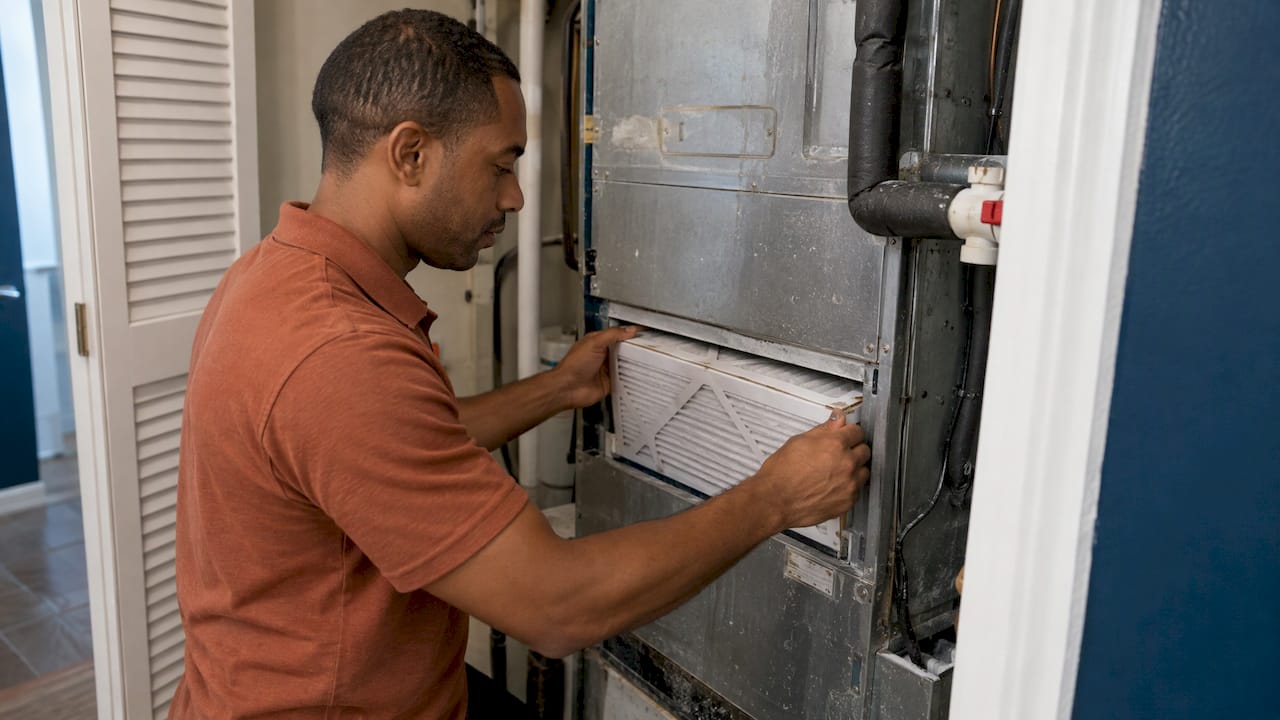
ENERGY STAR advises homeowners to inspect, clean or change central HVAC filters once a month, and notes that a dirty filter can raise energy costs and contribute to equipment damage and early failure. The Department of Energy adds that routine filter cleaning or replacement can lower an air conditioner’s energy use by 5 to 15 percent.
In a small condo closet the filter is often a quick swap. Write the date on the frame so you know when it was last changed. Keep the closet clear of boxes and the return grille unblocked, because restricted airflow is one of the most common causes of poor performance.
Once a year: the professional checkup
ENERGY STAR recommends an annual contractor checkup before the cooling season. Its checklist says the visit typically covers the thermostat, electrical connections, moving parts, the condensate drain and controls, plus the cooling coils, refrigerant level and blower components. The same page is your reference for what a complete visit should include.
The reason to use a professional for this is that the most damaging problems are invisible from the closet. The Department of Energy’s 2018 literature review notes that performance problems are commonly tied to improper airflow, incorrect refrigerant charge and duct performance. Measuring those takes tools and training.
Miami’s long cooling season changes the timing. Because your system works nearly year-round, spring is the natural checkup window, before the summer peak. Our guide on how often to service your AC in Florida goes through the local schedule in more detail.
In the first year after installation
A new system benefits from an early visit. The New York City Housing Preservation and Development maintenance plan for multi-unit buildings advises a first scheduled visit during the first year, while installation is still under warranty, to catch installation errors such as refrigerant leaks, insulation problems, short cycling or unsecured equipment. The same document describes building-level responsibilities that apply to any multi-unit property: keeping service logs, coordinating service visits and using a factory-authorized service company.
That last point matters for condos. Factory-certified technicians are trained on the equipment manufacturers build, and our technicians are factory-certified and background-checked, which matters when someone is entering your home or your building’s mechanical spaces.
What a condo AC checkup looks like
A good service visit follows a repeatable list. Use this as the standard whoever does the work:
| Item | Why it matters |
|---|---|
| Filter inspected or replaced | Protects airflow and energy use |
| Thermostat and controls tested | Confirms the system responds correctly |
| Electrical connections checked | Loose connections are a common failure point |
| Moving parts and blower checked | Worn parts raise noise and energy use |
| Cooling coils inspected | Dirty coils reduce cooling capacity |
| Refrigerant level checked | Incorrect charge hurts performance |
| Condensate drain and pan checked | Prevents leaks into your unit and the one below |
The table follows the ENERGY STAR checklist cited above. In a condo, the drain line deserves extra attention. A clogged line can overflow into your ceiling or a neighbor’s, and in a building with shared walls that becomes an insurance and association matter, not just an AC repair.
What condo maintenance costs
Pricing varies with system type and building access, so we publish what we can. A diagnostic visit with us starts at $89, and it is quoted flat-rate before work begins, so you know the number before a technician starts. Our AC repair page has the details.
For recurring care, our maintenance plans are priced monthly:
| Plan | Price |
|---|---|
| Essential | $24.95 per month |
| Comfort | $47.92 per month |
| Concierge | $83.33 per month |
The plans are designed to prevent breakdowns and extend equipment life. A monthly payment also turns the annual checkup from a task you postpone into something already scheduled, which is the main reason condo systems get skipped. You can compare them on our protection plans page.
How long a condo system lasts
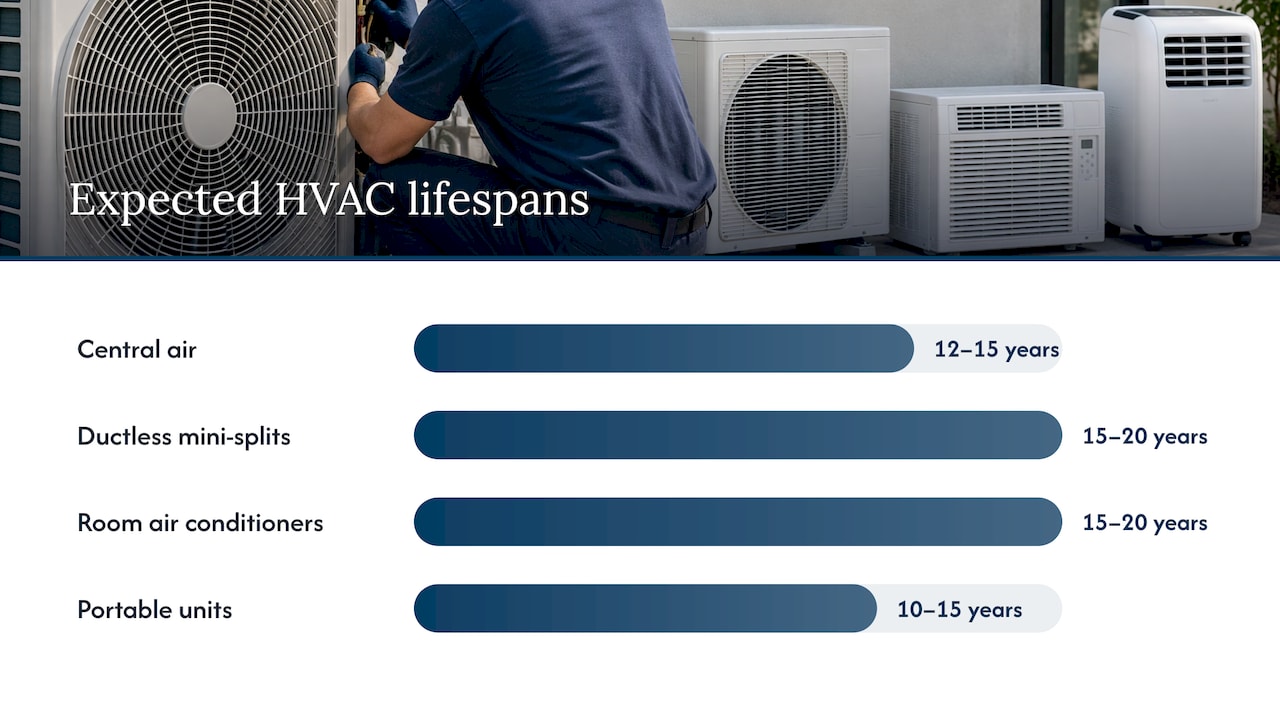
The Department of Energy lists expected lifespans of 12 to 15 years for central air conditioners and 15 to 20 years for ductless mini-splits, and says annual maintenance can help prolong an air conditioner’s life. Room air conditioners are listed at 15 to 20 years and portable units at 10 to 15.
The New York City plan cited earlier describes multi-unit VRF and split systems, a type of ducted-free system that serves several rooms from one outdoor unit, as having an expected life of 15 years or more, and says basic maintenance affects both efficiency and longevity.
In South Florida, salt air, humidity and near-constant run time are the factors that wear equipment. That is a reason to treat the ranges as a guide and to keep a service record. If you are choosing between system types for a condo, our comparison of central AC and mini-splits for Miami homes covers the trade-offs, and our guide to mini-split maintenance explains what the owner does and what needs a technician.
Repair or replace
Searchers often ask about the “$5,000 rule,” a rule of thumb that multiplies the system’s age by the repair cost and compares the result to $5,000. We would not hang a decision on a single formula. The government guidance is more useful.
A U.S. Department of Energy guide published by its Building America program says repair costs should be weighed against replacement costs in light of the system’s age and condition, and recommends replacement when repairs exceed half the cost of a new unit (the guide’s example is a furnace). A separate DOE diagnostic guideline lists a system more than 15 years old, compressor noise or failure, and a damaged or corroded condenser coil as reasons to consider replacing the condensing unit.
A practical way to apply this:
- Note the system’s age from the data plate.
- Get a flat-rate repair quote in writing.
- Compare it with the replacement cost. Our installation and replacement work is listed at $6,000 to $14,000, depending on the system.
- If the system is past 15 years or the repair is near half of replacement, replacement usually makes more sense.
Our articles on repair versus replacement in Miami and the signs you need a new AC walk through the decision. If you replace, ask your association first: many require written approval for changes to equipment visible from outside, such as a condenser on a balcony or roof. Our installation team offers financing on new AC and heat pump installs.
When the AC fails in a condo
A failed system in a high-rise in August is urgent, especially for families, elderly residents and owners with tenants. If the unit is yours, call a technician the same day. We offer emergency AC repair with same-day service, seven days a week across Miami-Dade.
If you see water coming from the air handler closet, turn the system off at the thermostat to stop more water forming, and tell your management office, since the neighbors below may be affected. Then book a technician.
Property managers and associations
If you run a building or manage a portfolio, the NYC plan is a helpful template for what good looks like: train building staff, coordinate service visits, keep service logs, and use a factory-authorized provider for annual and as-needed work. It also assumes residents clean indoor filters seasonally and suggests reminders every three months, which is an easy notice to add to your building’s newsletter.
For common-area equipment, our commercial HVAC solutions and our guide to commercial preventive maintenance cover the routine in depth.
Where we come in
If your condo’s AC is yours to maintain, the simplest way to protect it is a booked annual visit and a plan that keeps it on the calendar. Our technicians are factory-certified, pricing is flat-rate and quoted before work starts, and repairs carry a one-year warranty under our satisfaction guarantee. Plans start at $24.95 per month, and you can see them, along with our diagnostic and repair options, on our maintenance plans page.
If you also want cleaner air in a sealed condo, we install advanced filtration, dehumidifiers and UV purification, with indoor air quality services from $199. Details are on our indoor air quality page.
Our view
Most condo AC failures we are called to are the kind that a yearly visit is meant to catch: a neglected drain, a dirty coil, a system that has run for years without anyone looking at it.
Our approach is simple. We quote a flat rate before the work starts, send factory-certified, background-checked technicians, and stand behind repairs with a one-year warranty. For condo owners, that means one clear number and one accountable team, whether it is a routine tune-up or a Sunday-night breakdown.
We built our maintenance plans, from $24.95 per month, so that care happens on schedule instead of after a failure. In Miami’s heat, where the system rarely rests, that schedule is what extends equipment life and keeps summer from becoming an emergency.
Boreal
FAQ
Are condo owners responsible for HVAC?
Usually for the equipment that serves only their unit, but the declaration of condominium decides. Florida law makes the association responsible for common elements unless the declaration assigns maintenance to the owner. Read your documents and confirm with the management office.
How long does a condo HVAC last?
The Department of Energy lists 12 to 15 years for central air conditioners and 15 to 20 years for ductless mini-splits. Regular maintenance helps a system reach the upper end of its range. Heavy year-round use in South Florida makes a service record especially useful.
How much does it cost to have my HVAC serviced?
A diagnostic visit with us starts at $89, quoted flat-rate before work starts. If you want recurring checkups, our plans run $24.95, $47.92 or $83.33 per month. Final cost for repairs depends on the system and the problem, and we quote it upfront.
How often should a condo AC be serviced?
Check the filter monthly and book a professional checkup once a year, ideally before the hot season. ENERGY STAR gives the same filter and annual checkup guidance for central systems. A first visit during the first year of a new installation can catch installation issues while the warranty still applies.
Sources
- Florida Statutes 718.113, maintenance of common elements
- New England Condominium, HVAC Insider
- ENERGY STAR maintenance checklist
- DOE Home Cooling 101
- DOE residential HVAC installation practices review
- NYC HPD VRF and split-system maintenance plan
- Building America HVAC best practices guide
- DOE air conditioner diagnostics guideline
Recommended
- How Often Should You Service Your AC in Florida?
- Commercial HVAC Preventive Maintenance: A Practical Guide
- Mini Split Maintenance: What to Do Yourself and What Needs a Pro
- How Often to Clean Air Ducts: A Miami Homeowner’s Guide
Need a hand from a local pro?
Same-day AC repair and free installation quotes across Miami-Dade.
Call (786) 981-4223